


50% of software developers lose 10 or more hours every week to organizational inefficiencies (Atlassian State of Developer Experience 2025, n=3,500 across 6 countries). The popular diagnosis is notification overload, too many meetings, or too many tools. Those are real problems, but they're downstream of a more fundamental issue most engineering teams never identify.
The real velocity killer is context collapse: developers losing access to the WHY behind their work. Not just interruptions that break concentration, but the systematic erosion of the product decisions, architectural constraints, and team history that make engineering work coherent. When a developer doesn't know why a feature was scoped the way it was, or what constraints a past retro flagged for this module, they build the right thing the wrong way, or the wrong thing correctly.
That's not a focus problem. It's a planning context problem.
Key Takeaways
- 50% of developers lose 10+ hours/week to organizational inefficiencies; finding information is a top-3 time drain (Atlassian DevEx 2025, n=3,500)
- Context collapse is distinct from context switching: it's losing the WHY of the work, not just the thread of attention
- Faros.ai study of 10,000+ developers: AI-assisted teams merged 98% more PRs but PR review time ballooned 91%, because reviewers lacked the context to evaluate AI-generated code
- ACM Queue (2026): A new framework identifies "cognitive debt" and "intent debt" as more dangerous than technical debt for AI-era engineering teams
- Architecture Decision Records (ADRs), endorsed by Google, AWS, and the UK Government Digital Service, are the primary structural fix
What Is Context Collapse?
Context collapse, in engineering, is what happens when the shared understanding of a system, why it was built a certain way, what decisions were made and why, what the team tried and abandoned, erodes faster than it's replenished. Every team accumulates this shared understanding over time. It lives in the heads of senior engineers, in scattered Confluence docs, in commit messages, in retro notes nobody reads. When any of those sources goes stale or disappears, the team loses context.
The most visible form is classic context switching: an engineer interrupted mid-task takes 23 minutes and 15 seconds on average to fully regain focus (Gloria Mark, UC Irvine, "The Cost of Interrupted Work"). That number is real and the research is solid. But it describes attention recovery, the cost of a broken thread.
Context collapse is different. It's the cost of the missing thread. An engineer who has never been told why the authentication module was rebuilt six months ago will make decisions that contradict the constraints that drove the rebuild. An AI tool generating a sprint plan without access to those decisions will propose work that re-creates solved problems. No amount of focus will compensate for the missing context, because the problem isn't concentration, it's information.
How Does Context Collapse Happen in Engineering Teams?
Context collapse doesn't arrive as a single event. I've seen it build through four patterns, consistently, across teams of all sizes:
1. Decision records that don't exist. Most engineering decisions aren't captured at all, they're made in a Slack thread, a video call, or a whiteboard session that nobody photographs. The decision gets implemented. The reasoning disappears. The next engineer who touches the code inherits the outcome without the constraint.
2. Documentation that decays. Confluence pages and Notion docs are updated when they're created and rarely after. 63% of developers say leaders don't understand their pain points (Atlassian DevEx 2025), a proxy for how poorly knowledge flows through engineering organizations. Developers build mental models from documentation, but the documentation reflects a system that no longer exists.
3. Tribal knowledge that departs. When the senior engineer who built the payments module leaves, so does the context for every undocumented decision in it. The codebase remains. The reasoning doesn't.
4. Planning that operates in isolation. When sprint planning doesn't reference the retrospective findings from the last three cycles, doesn't pull from customer interview transcripts, and doesn't account for the architectural decision records in the relevant modules, teams plan without the context their work requires. The plan looks correct. The execution surfaces problems that good context would have prevented.
Why Is Context Loss More Expensive Than Interruptions?
The classic productivity research focuses on attention: a 23-minute recovery time per interruption, a preference for half-day blocks of uninterrupted work (Paul Graham, Maker's Schedule, Manager's Schedule, 2009). These findings are real. But they frame the cost of context loss as a time-recovery problem, how long it takes to resume the thread.
The deeper cost is in what gets built without the context. 56% of all software defects originate in the requirements phase, decisions about what to build and how to specify it, not in the implementation (CISQ / IBM Systems Sciences Institute). When a developer doesn't have the context to understand a requirement accurately, defects propagate from the planning layer through to production. The bug isn't a coding error, it's a planning error that couldn't be caught because the context for catching it wasn't available.
The Faros.ai research makes this visible at scale. In a study of 10,000+ developers across 1,255 teams, AI-assisted developers merged 98% more pull requests but PR review time ballooned 91% (Faros.ai, July 2025). Bugs per developer increased 9%. Net organizational throughput: zero improvement. The explanation is context collapse at the review layer: AI generates PRs faster than reviewers can evaluate them, because evaluation requires context that isn't in the PR, it's in the architectural decision record, the retro finding, the customer interview that motivated the feature.
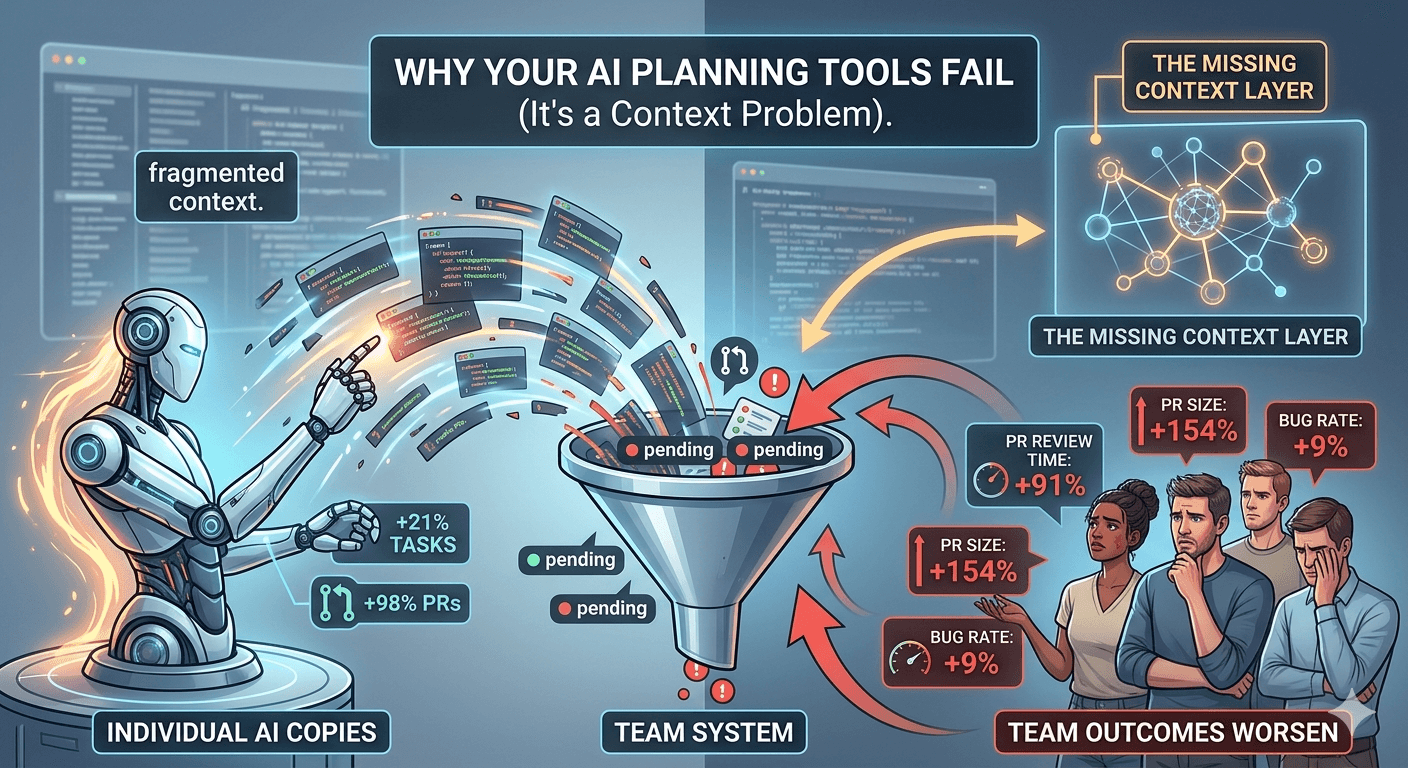
Why AI Planning Tools Fail: The Missing Context Layer
What Does Context Collapse Cost in Practice?
A new framework from Margaret-Anne Storey (University of Victoria, co-author of SPACE and DevEx) published in ACM Queue in early 2026 introduces cognitive debt and intent debt alongside technical debt:
- Technical debt lives in code: deferred refactoring, architectural shortcuts, undocumented workarounds.
- Cognitive debt lives in people: the shared understanding that makes a software system safe to change, quietly eroding as the team grows, changes, or just stops talking about the system.
- Intent debt lives in artifacts: goals and constraints guiding the system that are poorly captured or maintained, PRDs that don't reflect current scope, ADRs that were never written, retro findings that weren't actioned.
Gartner, cited in coverage of the framework, projects that 75% of technology leaders will face moderate or severe cognitive or intent debt problems by 2026 as AI-accelerated coding practices outpace knowledge management. The code ships faster. The understanding of the code stays the same.
DORA 2024 adds a measurement angle: unstable organizational priorities substantially decrease productivity and increase burnout, even in environments with strong leadership and quality documentation (DORA State of DevOps 2024). The strongest interpretation: documentation isn't enough if priorities are unstable. Context collapse isn't just missing docs, it's missing direction. When the plan changes without explanation, developers can't maintain a coherent model of what they're building and why.
How Do You Know If Your Team Has Context Collapse?
Context collapse is rarely self-diagnosed. Teams attribute the symptoms to other causes, velocity is down because of technical debt, estimates are wrong because engineers are bad at estimating, the retro actions never get done because the team is too busy. Five signals point directly to context collapse:
1. Re-work on recently shipped features. If engineers regularly need to substantially rework or reverse decisions made in the previous 1 to 3 sprints, the feature was built without sufficient context for the decision being made.
2. The same retro finding appears repeatedly. If "dependency communication" or "unclear requirements" appears in retros for three consecutive sprints, it's a context distribution problem, the team is re-learning the same lesson because the learning isn't being captured and made accessible.
3. Senior engineers are bottlenecks. When work only moves when a specific senior engineer is available to explain context, that context isn't documented. The senior engineer is serving as the team's Context Lake.
4. AI-generated code requires heavy review cycles. If your team's AI-assisted PR review time is increasing faster than PR volume, reviewers lack the context to evaluate AI output quickly. The code isn't the problem, the missing architectural context is.
5. Sprint plans regularly break during execution. Not because of unexpected scope changes, but because execution reveals constraints that were known, they just weren't in the room when the sprint was planned.

How Do You Build Context-Preserving Engineering Workflows?
The fix is structural, not a pep talk. Asking teams to "document better" without changing how and where documentation happens just produces better-intentioned Confluence pages that decay as fast as the last batch.
Fix 1: Architecture Decision Records (ADRs) at the point of decision
An ADR captures: the context of the decision, the decision itself, the options considered and rejected, and the expected consequences. ADRs are formally endorsed by Google Cloud, AWS, and the UK Government Digital Service (December 2025). The critical practice: ADRs are written at the moment of decision, stored alongside the code in version control, and never deleted, only superseded.
The discipline: every non-trivial architectural decision triggers an ADR. Not every Jira ticket, but every decision about how a module is structured, which library is chosen, or why a previous approach was abandoned. Fifteen minutes of writing now prevents days of reverse-engineering later.
Fix 2: Structured retrospectives with persistent output
A retro that produces a Confluence page of action items has already failed. Retro findings must become backlog items, issues in the same system the team uses to plan work. Every action item gets an owner, a priority tier, and a sprint assignment. Retros that produce backlog items get implemented. Retros that produce documents get archived.
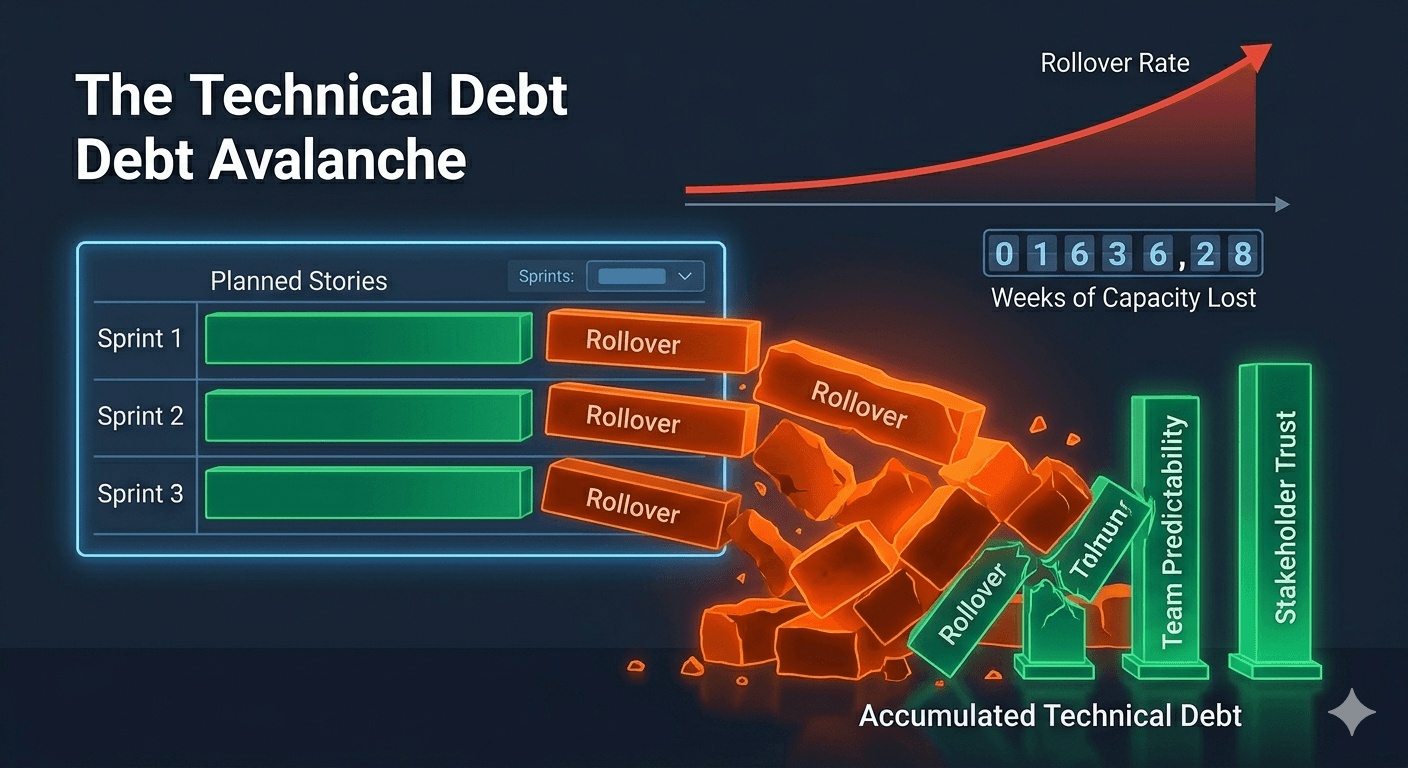
Why 80% of Agile Sprints Roll Over (and How to Fix It)
Fix 3: Context-aware sprint planning
Sprint planning that references the last three retrospectives, the open ADRs in the modules being touched, and the customer research driving current epics produces fundamentally better plans than planning from a blank backlog. This is the difference between a planning meeting that opens with "what should we build?" and one that opens with "here's what the system knows, what do we want to add or change?"
How Does a Context Lake Fix Context Collapse?
A Context Lake is a centralized, AI-readable repository that ingests every artifact from your software lifecycle, PRDs, pull requests, retrospectives, ADRs, customer interviews, sprint history, and structures them so that AI planning systems can reason across all of it simultaneously.

What Is a Context Lake? The AI-Native Planning Memory Layer
The specific fix for context collapse: every time a sprint is generated, the AI reads the full context graph, not just the current backlog. It sees the retro finding from Sprint 14 that flagged authentication module instability. It sees the ADR that prohibits direct database connections in the API layer. It sees the customer interview transcript where three customers mentioned the same UX friction in the checkout flow. None of that context requires a human to remember it or a meeting to surface it.
The shift MIT Technology Review identified as "from vibe coding to context engineering" (MIT Technology Review, November 2025) is exactly this: the next frontier in engineering productivity is not generating code faster, but managing what AI systems know about the system they're generating code for. Context engineering is the discipline that makes AI planning trustworthy.
Frequently Asked Questions
What is the difference between context switching and context collapse?
Context switching is an attention problem: an interruption breaks a developer's concentration and costs 23 minutes to recover. Context collapse is an information problem: a developer or planning system lacks access to the decisions, constraints, and history that make their work coherent. Context switching slows individual developers. Context collapse degrades entire teams' planning quality and execution accuracy.
Why is context collapse getting worse as AI adoption increases?
AI accelerates code production without accelerating context production. AI-assisted developers ship more PRs, but reviewers need the same context to evaluate each PR that they always did, and there's now more PRs to evaluate. The Faros.ai 2025 study found PR review time increased 91% with AI adoption while net organizational throughput stayed flat. The bottleneck shifted from generation to understanding.
What is cognitive debt and how does it differ from technical debt?
Technical debt lives in code: deferred refactoring, architectural shortcuts, workarounds. Cognitive debt lives in people: the shared understanding that makes a system safe to change, eroding as teams grow and knowledge isn't captured. Margaret-Anne Storey's 2026 ACM Queue framework argues cognitive debt is now more dangerous than technical debt for most engineering teams because it's invisible until it manifests as defects, rollover, or rework.
How do Architecture Decision Records prevent context collapse?
ADRs capture the context, decision, options considered, and expected consequences at the moment of decision. Stored in version control alongside code, they give any engineer (or AI planning system) access to the reasoning behind the system's current shape. Google, AWS, and the UK Government Digital Service formally endorse ADRs as a standard engineering practice. The key discipline: write them at decision time, not as documentation cleanup afterward.
How long does it take to recover from context collapse?
Recovery depends on how much context was lost and what systems were in place to capture it. If ADRs and structured retros were partially maintained, recovery may take 2 to 3 sprints as the team re-documents key decisions and loads them into a structured repository. If context was entirely tribal, expect 4 to 8 weeks of deliberate documentation work before a planning system, human or AI, can operate with reliable context. The investment is one-time; the benefit compounds every sprint afterward.