

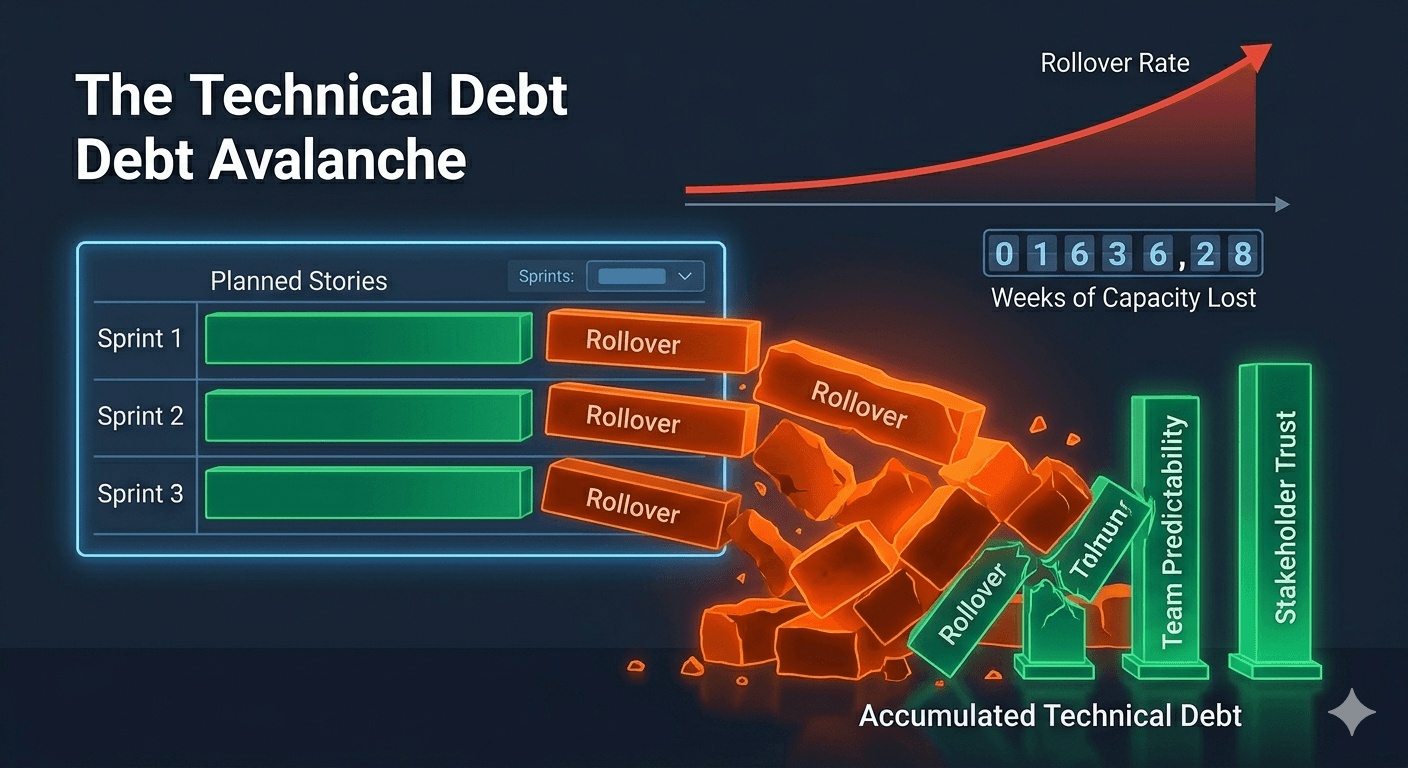
80% of Agile teams carry incomplete work into the next sprint. Most engineering leaders treat this as a motivation problem, a skills problem, or a velocity problem. It is none of those. The data from 419 engineers across five countries points to three specific, structural causes, and every one of them is a planning failure, not a people failure.
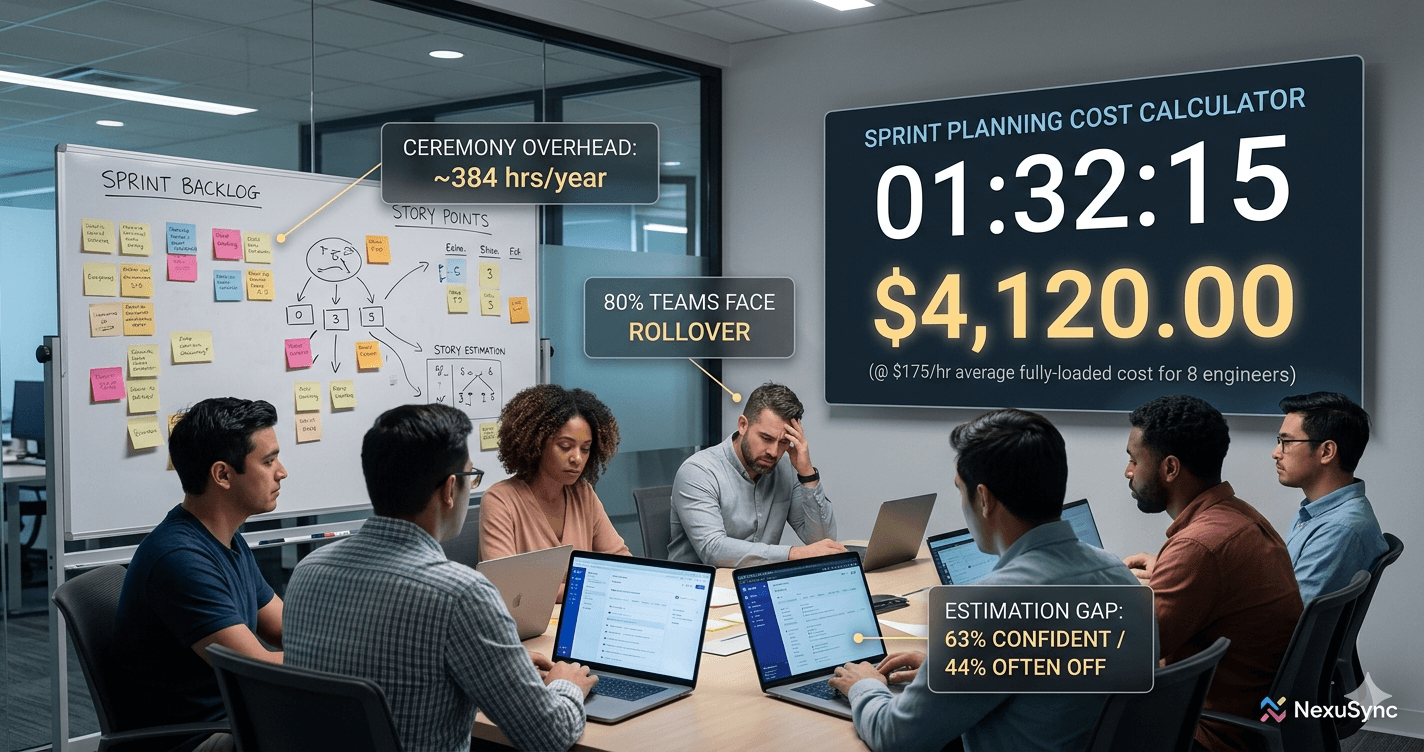
How to Cut Sprint Planning Overhead (And Recover $57K/Year)
Key Takeaways
- 80% of Agile teams roll over incomplete work every sprint; only 20% finish cleanly
- Dependency delays are the single largest rollover cause, cited by 36% of teams
- High estimation confidence does not mean high estimation accuracy, the data shows a significant gap
- Elite engineering teams (DORA 2024) have manually built the planning discipline that AI-native tools automate
- Sprint rollover is a leading indicator of project failure, not a lagging one
What Does the Data Show About Sprint Rollover?
Eight in ten Agile teams roll over incomplete work every sprint, according to Easy Agile Research published in February 2026, based on a survey of 419 engineers across five countries (Easy Agile Research, Feb 2026). Only 20% of teams report minimal rollover. This is not a sample of dysfunctional teams. It is a cross-industry baseline.
That 80% number should stop you cold. Rollover is not an edge case. It is the default state of Agile delivery for most organizations. When four out of five teams are failing to close a sprint cleanly, the cause cannot be individual performance. The cause is systemic, built into how teams plan, estimate, and track work.
The same study identifies three root causes. Each one is distinct. Each one is measurable. And each one is fixable with the right process changes, or the right tooling.
Cause 1, Dependency Blindness (36%)
Dependency delays are the single most common cause of sprint rollover, cited by 36% of teams surveyed (Easy Agile Research, Feb 2026, n=419). A story is scoped, pointed, and committed. Then another team misses a deadline, an API isn't ready, or a design approval sits in someone's inbox for four days. The sprint absorbs the hit.
The core problem is that dependency tracking is manual. Dependencies live in people's heads, Slack threads, and Jira fields that nobody updates until something breaks. By the time a dependency slip surfaces as a blocker, the sprint is already mid-flight. There is no recovery play, only rollover.
Most teams do not have a dependency register. They have a dependency assumption: that the work they planned will land without external interference. In complex software delivery, that assumption fails constantly. And it fails invisibly until it's too late to replan.

What Is a Context Lake? The AI-Native Planning Memory Layer
Cause 2, The Confidence Paradox
63% of Agile practitioners report feeling highly confident in their sprint estimates, yet 44% say their tasks end up significantly off-estimate at least half the time (Easy Agile Research, Feb 2026, n=419). High confidence coexists with systematic inaccuracy. This is not a contradiction. It is a calibration problem.
Teams estimate from memory. A story looks like a similar story from two sprints ago. The senior engineer estimates based on how long it took the last time they built something comparable. The team agrees in the planning meeting, and everyone genuinely feels good about the number.
In our experience building planning tooling at NexuSync, teams almost never track estimation accuracy by story type. They feel the pain of overruns but cannot locate the pattern. They miss that API integration stories consistently run 40-60% over, while internal tooling stories are reliably accurate. Without that breakdown, every planning cycle starts from the same flawed baseline.
The confidence is real. The calibration is not. And because the team trusts its own confidence, it does not demand better inputs.
Why Do Teams Plan with Radically Incomplete Context?
The root cause behind dependency blindness and estimation overconfidence is the same: teams plan with radically incomplete information. A typical sprint planning session uses three inputs: a list of tickets, a capacity spreadsheet, and last sprint's velocity number.
Estimation without full context is guesswork wearing a process costume. The ticket exists. The points get assigned. The ceremony completes. But the underlying information gap means the sprint is fragile from the moment it starts.

Context Collapse: The Hidden Engineering Velocity Killer
59% of teams still use spreadsheets as a primary sprint planning tool (Easy Agile Research, Feb 2026). Spreadsheets cannot model real-time dependency status, cannot surface historical estimation error by story type, and cannot alert the team when a dependency shifts mid-sprint. They are static documents in a dynamic delivery environment.

What Do the 20% Do Differently?
The 20% of teams that finish sprints cleanly share practices that mirror what DORA research identifies as elite engineering behaviors. Only 19% of engineering teams qualify as elite performers in the DORA 2024 Report, while the low-performance tier grew from 17% to 25% (DORA 2024 Report). Elite teams deploy 182x more frequently than low performers, with lead times 127x shorter (DORA Accelerate State of DevOps 2024). That velocity requires plans that actually hold.
What distinguishes them is not better engineers. It is better planning inputs. Elite teams maintain written dependency registers, updated before planning, not during a blocker. They tag velocity history by story type, so estimates draw on actual performance data, not gut feel. They write clear acceptance criteria before planning begins, so scope ambiguity is resolved before commitment.
They have manually constructed what AI-native planning can automate. That is why they are the 20%.
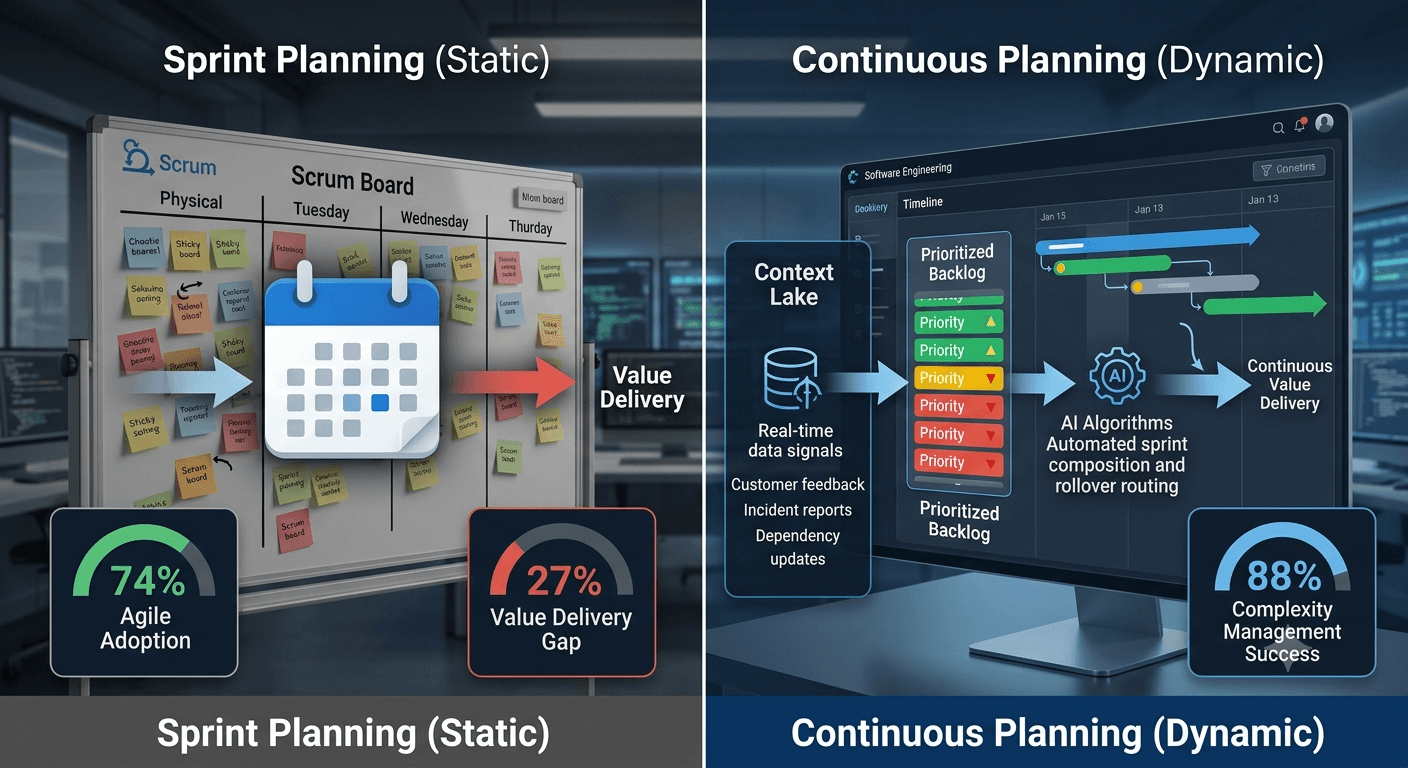
The Complete Guide to Continuous Planning for Software Teams
What Is Sprint Rollover Actually Costing Your Team?
The financial and strategic stakes of sprint rollover extend well beyond missed sprint goals. PMI's Pulse of the Profession 2026 found that 31% of complex projects fail to achieve their intended benefits in 2026, more than double the 12% rate from 2024 (PMI Pulse of the Profession, May 2026). The same report found that 80% of complex projects experience negative fallout from poorly managed complexity (PMI Pulse of the Profession, May 2026).
Sprint rollover is not a lagging indicator of project failure. It is a leading one. Every story that rolls compounds into technical debt, reduced team predictability, and eroded stakeholder trust. A 10-point reduction in rollover rate, for example, moving from 40% to 30%, compounds into weeks of recovered capacity per quarter at team scale.

Why Fixed Sprint Cycles Break Modern Engineering Teams
Which Three Metrics Should You Track Starting This Sprint?
You do not need new tooling to start measuring rollover causes. You need three numbers, tracked consistently from this sprint forward.
1. Rollover rate. Stories not completed divided by stories planned. Track this every sprint, not quarterly. Target: under 20%. If your rollover rate is above 30%, you have a structural planning problem, not a capacity problem.
2. Dependency delay incidents. Count the sprints where at least one story slipped because another team or external dependency slipped. More than one per sprint means your dependency tracking process is broken. That number compounds fast.
3. Estimation accuracy by story type. Log your estimate and your actual for every story, tagged by category: API work, frontend, infra, migrations, integrations. Within three sprints, you will see where you systematically overestimate and underestimate. That is the calibration data your planning is currently missing.
These three metrics will not fix rollover by themselves. But they will locate the specific failure mode driving your team's rollover, and tell you which of the three causes above is costing you the most.
If 80% of teams are rolling over work every sprint, the problem is not the team. It is the process.
Frequently Asked Questions
What is sprint rollover?
Sprint rollover occurs when work planned for a sprint is not completed by the sprint's end and carries into the next sprint. It is distinct from backlog reprioritization. According to Easy Agile Research (Feb 2026, n=419), 80% of Agile teams experience this regularly.
What causes sprint rollover most often?
The most commonly cited cause is dependency delays, reported by 36% of teams, according to Easy Agile Research (Feb 2026). Estimation overconfidence and planning with incomplete context are the other two primary causes. All three stem from information gaps in the planning process, not from team performance issues.
Why do teams consistently overestimate what they can deliver?
63% of practitioners feel highly confident in their estimates, yet 44% report tasks are significantly off-estimate at least half the time (Easy Agile Research, Feb 2026). Teams estimate from memory and pattern recognition, not from typed historical data. Confidence is high because the process feels rigorous. Accuracy suffers because the inputs are incomplete.
What do elite engineering teams do differently to avoid rollover?
Elite performers, who represent 19% of engineering teams (DORA 2024), use written dependency registers, typed velocity history, and pre-written acceptance criteria before planning begins. These practices give planning sessions complete context. Elite teams deploy 182x more frequently than low performers, which requires delivery plans that hold sprint after sprint.
How do you reduce sprint rollover without adding more process overhead?
Start by tracking three metrics: rollover rate, dependency delay incidents, and estimation accuracy by story type. These three data points reveal which cause is dominant for your team. From there, target that specific failure: build a dependency register, tag your velocity history, or push acceptance criteria to pre-planning. Adding AI-native planning context addresses all three simultaneously.