


Here's the argument nobody in your Agile certification course made: the two-week sprint is not a neutral container. It encodes an assumption, that software work is divisible, predictable, and bounded enough to plan in 14-day batches. For a small class of work, that assumption is true. For most engineering work at companies with competitive pressure, multiple stakeholders, and dependencies across teams, it is false.
The ceremony overhead isn't waste to be optimized. It's the cost of maintaining the illusion that the 14-day model is working.
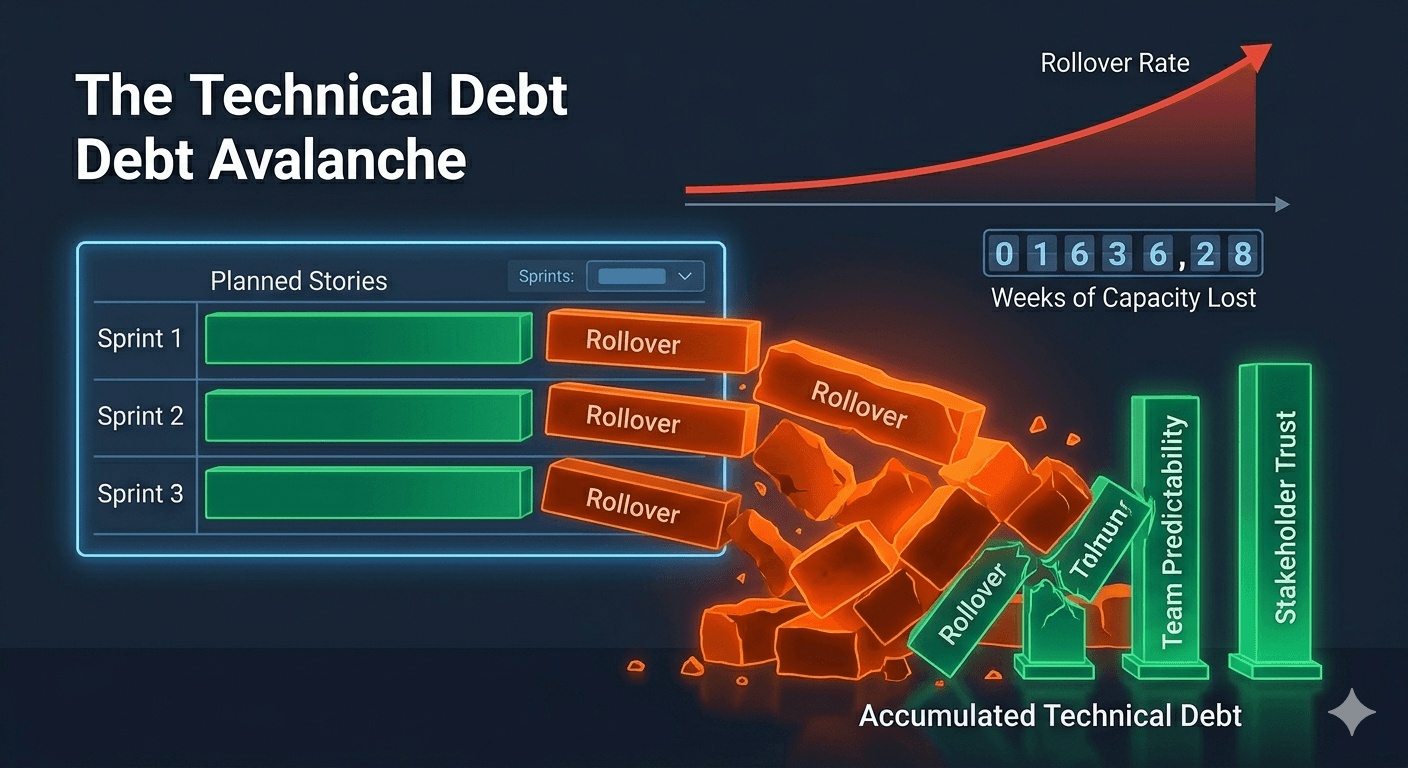
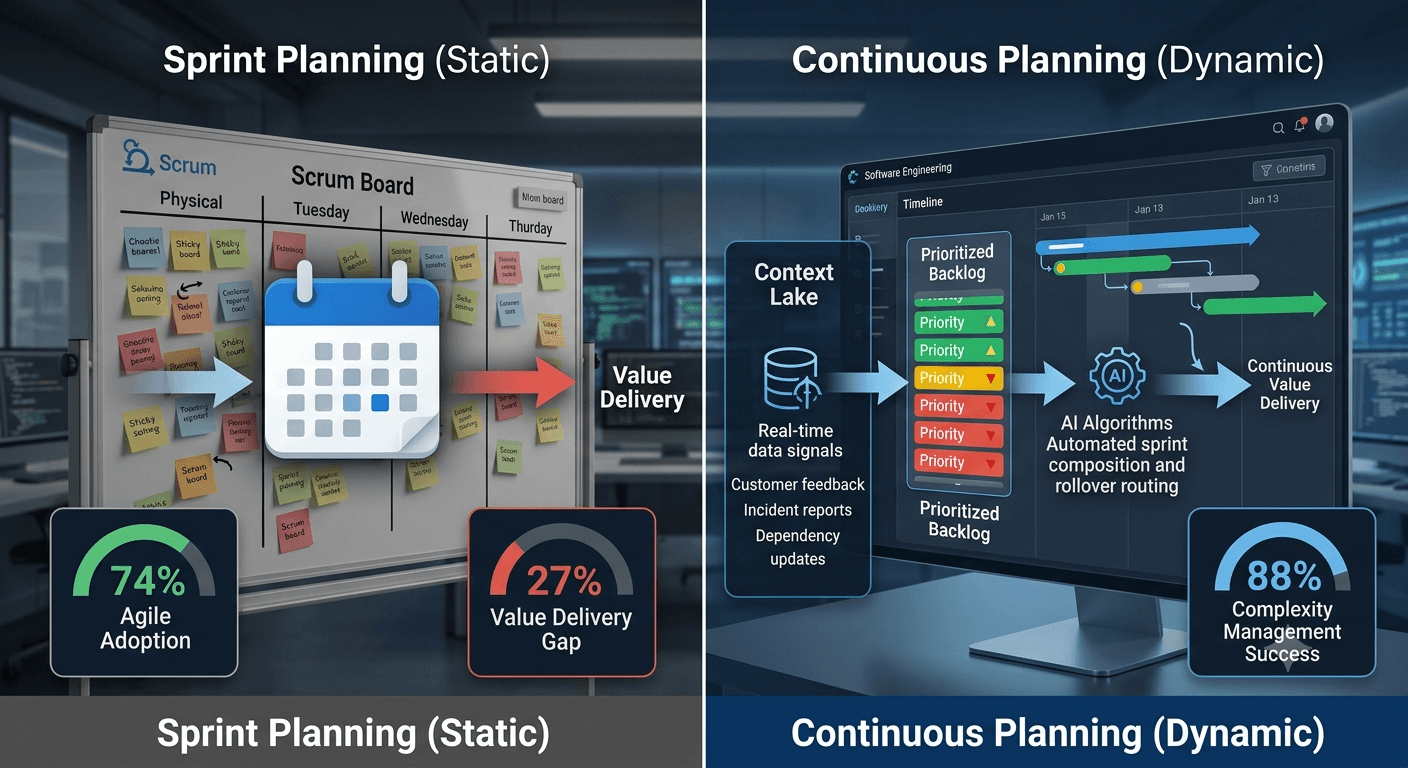
80% of agile teams carry incomplete work into the next sprint every cycle (Easy Agile State of Team Alignment 2026, n=419 across 5 countries). Only 27% of teams say Agile is enabling them to deliver value, despite 74% using Agile or hybrid Agile approaches (Digital.ai 18th State of Agile Report, 2025). These are not outlier numbers from teams doing it wrong. They're the median.
Key Takeaways
- 80% of agile teams regularly carry incomplete work into the next sprint, not as an anomaly, but as the norm
- Only 27% of teams say Agile is enabling value delivery despite 74% adoption (Digital.ai 2025)
- DORA 2024: Elite performers (19% of all teams) deploy on demand with sub-day lead times, they do not use sprint-gated releases
- Netflix, Basecamp, Babylist, and Spotify have all independently moved away from 2-week fixed sprints and arrived at similar conclusions
- Fixed sprint failures are not execution problems, they are structural features of the model itself
What Does the Data Show About Sprint Performance in 2026?
The Easy Agile State of Team Alignment 2026 survey (n=419 engineers, product managers, and Scrum Masters across the US, UK, Germany, Canada, and Australia) produces three numbers that, taken together, describe a planning system that has stopped working:
- 80% of teams regularly experience sprint rollover. Only 20% achieve minimal (0 to 10%) rollover.
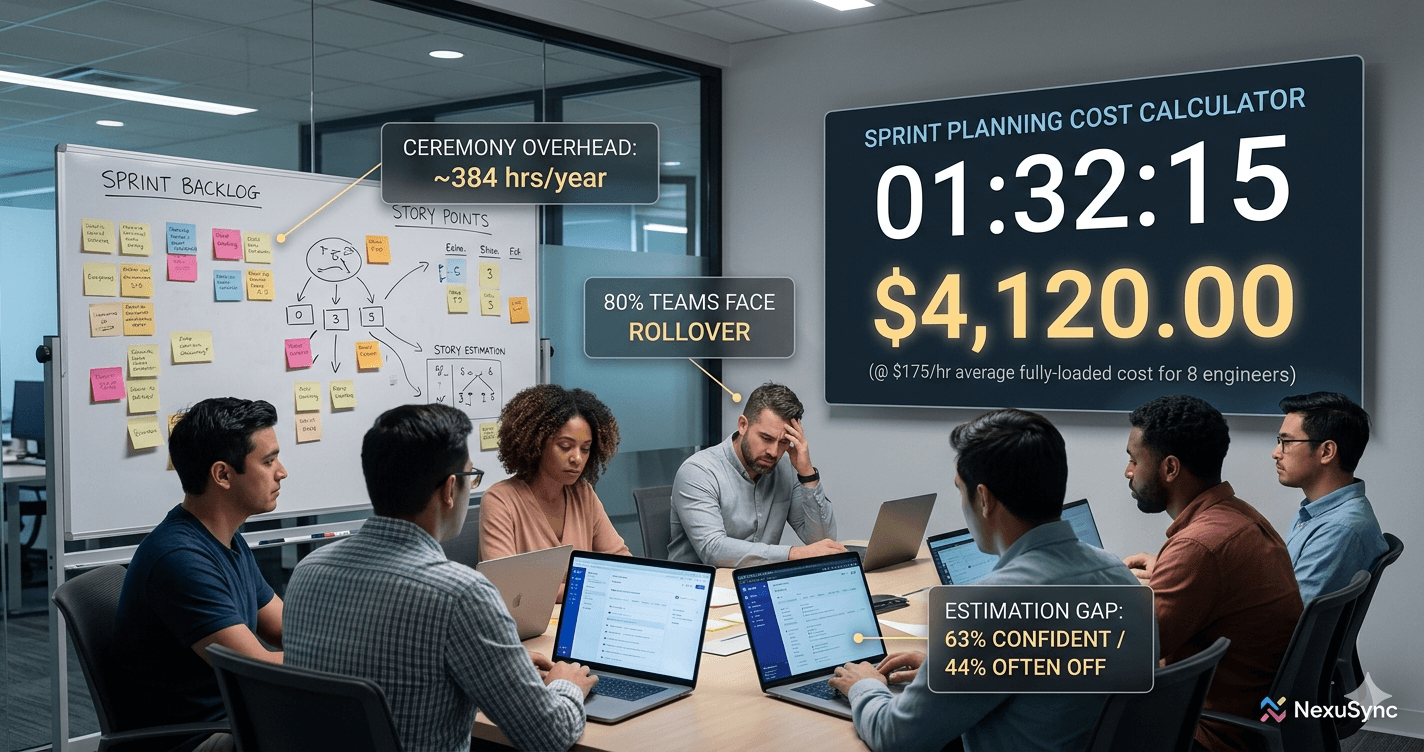
- 63% of teams feel confident in their estimates. Yet 44% report tasks are significantly mis-estimated at least half the time.
- Over one-third of teams roll 26 to 50% of planned sprint work forward every cycle. That's not an outlier sprint, that's the regular cadence.
These numbers describe a planning system where the majority of teams cannot reliably ship what they plan inside the time boundary they plan it in. The response from the agile consulting industry has been consistent: better retrospectives, better estimation techniques, better facilitation, better backlog grooming. Teams that have been running sprints for five years have better retros than they did in year one. The rollover number hasn't moved.
Better execution hasn't moved the number. That's the evidence that the model itself is the problem, not the teams running it.
Why Do Fixed Cadences Feel Safe But Produce Chaos?
The appeal of the two-week sprint is transparency. At any given moment, everyone knows what the team is committed to for the next 14 days. Stakeholders can predict what will ship. Engineers know what to work on. The sprint board gives the appearance of a controlled system.
The appearance is load-bearing. The ceremony continues, estimation, planning, review, retro, because stopping the ceremony would require admitting that the plan it produces isn't being followed. Plans changing too often is the #1 challenge facing agile teams, cited by 33% of respondents (Digital.ai 18th State of Agile Report, 2025). The irony: the problem is that plans change too often. The ceremony was supposed to prevent that.
A typical 2-week sprint for a 7-person team produces approximately 18 hours of ceremony overhead per sprint (planning, daily standups, sprint review, retrospective, and refinement), roughly 22% of team capacity (Software Process and Measurement, Cagle, 2020). That overhead isn't optional. It's the maintenance cost of the model. And it runs whether or not the model is producing reliable plans.
The deeper structural failure: the sprint is a time-box, not a scope-box. The ceremony treats it as a scope commitment, but the real constraint is time. When reality diverges from the plan, and it always does, the time-box holds while scope either collapses (rollover) or expands (quality debt, missed dependencies, unplanned work). The sprint ceremony is not a planning tool for complex software. It's a coordination protocol that was retrofitted into a planning role it wasn't designed for.
Why Was the 2-Week Sprint Built for a Different Era?
The Agile Manifesto (2001) was written in response to waterfall project management, 18-month planning cycles with change orders and requirements freeze dates. The two-week sprint was a radical improvement over that. It introduced feedback loops that waterfall didn't have. It reduced the batch size of decisions from years to weeks. It was the right architecture for 2001.
The software delivery environment has changed materially since then. Deployment pipelines that once required weeks now run in hours. DORA 2024 finds that elite performers, 19% of all teams surveyed, deploy on demand, multiple times per day, with lead times under one hour (DORA State of DevOps 2024). They do not release on sprint boundaries. They don't need to. The code is always in a releasable state.
For teams with continuous delivery capability, the sprint boundary creates a planning bottleneck that didn't previously exist. Work that's done on day 8 waits until day 14 to ship. A priority shift on day 10 waits until the next planning ceremony to take effect. The two-week batch was an improvement over 18-month batches. It is now a constraint on teams that can operate at much smaller batch sizes, if the planning model allows it.
AI-assisted development makes this worse. DORA 2024 found that AI tooling correlated with worsened software delivery performance for the second year in a row, partially because AI increases the average size of pull requests. Larger PRs in a sprint-gated release model means larger batches shipped at the sprint boundary. The batch size problem compounds.
What Did Teams That Abandoned Fixed Sprints Actually Find?
The argument against fixed sprints isn't theoretical. It's been run in production at notable engineering organizations, and the findings are consistent.
Basecamp (37signals): Published the Shape Up methodology after abandoning 2-week sprints entirely. Core finding: sprint boundaries create "graveyards of ideas no one will ever build" as rollover stories accumulate and never get deprioritized. Shape Up replaces sprints with 6-week appetite cycles with hard scope cuts, if it doesn't ship in 6 weeks, the project is cancelled, not carried over. The appetite model treats scope as variable and time as fixed.
Babylist (engineering team case study, Built In): Publicly documented switching from Scrum sprints to Shape Up 6-week cycles. Key finding: 2-week sprints "feel like an endless hamster wheel with no time to reflect." A cooldown period between cycles reduced burnout and improved team ownership of decisions. Published as a firsthand account from engineering leadership.
Netflix: Plans on semester boundaries, not two-week sprint cycles. Uses the RICE prioritization framework (Reach, Impact, Confidence, Effort) to align delivery to longer planning horizons. Published in Stripe's Increment magazine by Netflix engineering leadership, a firsthand account of a planning model that explicitly rejects the sprint as an organizing unit.
Spotify: Squads choose their own methodology (Scrum, Kanban, or hybrid). At the delivery layer, a Release Train ships weekly regardless of individual squad sprint boundaries, explicitly decoupling planning cadence from delivery cadence. The Spotify model treats the sprint as an internal coordination tool, not a release gate.
These organizations didn't coordinate their departures from fixed sprints. They arrived at similar conclusions independently, across different tech stacks, team sizes, and business models. The common thread: at a certain level of delivery maturity, the two-week fixed cadence becomes a coordination tax, not a coordination benefit.
Why 80% of Agile Sprints Roll Over (and How to Fix It)

What Does Continuous Planning Replace Fixed Sprints With?
Continuous planning doesn't eliminate time horizons. Teams still need to know what they're working on and for how long. What continuous planning eliminates is the fixed ceremony that creates the illusion of control, and the rollover cascade that follows when reality diverges from the plan.
The practical difference: instead of a plan that's created once and held for 14 days, the team has a plan that's always current. The backlog is always prioritized. Capacity is calculated from real availability, not from theoretical headcount. Rollover happens automatically by priority tier, P0/P1 items carry forward; lower-priority items return to the backlog without a ceremony.
The planning meeting becomes a 30-minute review of what the system has already composed, not a 2-hour creation event starting from a blank board. Dependency conflicts are surfaced before the meeting, not discovered during execution. Priority shifts get incorporated when they happen, not at the next ceremony.
The Complete Guide to Continuous Planning for Software Teams
The key insight from Shape Up, Netflix, Babylist, and Spotify: what these teams preserved wasn't the ceremony, it was the discipline. Deciding what to build and why still requires human judgment. Committing to deliver something in a given window still creates accountability. What they eliminated was the overhead of maintaining a planning container that doesn't fit the work.
How Do You Start Transitioning Away From Fixed Sprints?
The transition doesn't require abandoning Scrum overnight. Most teams move in three phases:
Phase 1: Measure the actual overhead. Track total planning time for one sprint: the ceremony, pre-planning grooming, and the first three days of reactive replanning when the plan breaks. Most teams find the real overhead is 2 to 3× what they estimated. Quantify it before changing anything.
Phase 2: Separate planning cadence from delivery cadence. Start shipping when work is done rather than on sprint boundaries, even while keeping the planning ceremonies. This decouples the delivery question (when can this ship?) from the planning question (what are we working on?). It's the single change with the highest immediate ROI.
Phase 3: Replace creation with review. The planning ceremony shifts from building the sprint from scratch to reviewing a system-generated draft. This requires a live, prioritized backlog and a velocity baseline, both of which can be set up in one sprint.
How to Cut Sprint Planning Overhead (And Recover $57K/Year)
The teams that make this transition fastest share one characteristic: they stopped defending the two-week sprint as a sacred artifact of the Agile Manifesto, which, for the record, never mentions sprint length, and started treating it as a tool to be evaluated like any other.
Frequently Asked Questions
Are fixed sprint cycles inherently broken or just misused?
For teams that can't continuously deliver, fixed sprint cadences provide coordination structure. The problem arises when teams treat the sprint as a commitment to scope rather than a container for time, and when the maintenance overhead of the model exceeds the planning value it provides. For teams with 80%+ rollover rates and sub-30% retro action completion, the model is producing more overhead than value, regardless of how well it's being run.
What does Agile recommend about sprint length?
The Scrum Guide recommends sprints of four weeks or fewer and does not mandate two weeks. Many Agile coaches advise two weeks as a default, but it's a convention rather than a specification. Teams that operate on a one-week, three-week, or six-week cycle are still practicing Agile. The ceremony overhead scales with sprint frequency, shorter sprints mean more ceremonies per year.
How do DORA's elite performers plan without fixed sprint cycles?
Elite performers (19% of DORA 2024 respondents) deploy on demand with sub-day lead times. Their planning is event-driven rather than cadence-driven: priorities update when information changes, not when the calendar permits. Most use some form of rolling backlog with explicit priority tiers, work that's high priority gets done; work that isn't gets deprioritized or cancelled, not carried forward indefinitely as rollover.
What is Shape Up and how does it differ from Scrum?
Shape Up (37signals/Basecamp) replaces the two-week sprint with 6-week "appetite" cycles. The key difference: scope is variable and time is fixed. A feature gets 6 weeks; if it doesn't ship, it's cancelled, not carried over. This eliminates the rollover accumulation that characterizes most Scrum implementations. Between cycles, a cooldown period allows teams to reset, fix bugs, and reconsider next cycle's work without a sprint commitment active.
Can a team transition from fixed sprints to continuous planning incrementally?
Yes. The three-phase approach, measure overhead, decouple delivery from planning cadence, replace ceremony creation with system review, allows teams to reduce sprint overhead without abandoning the coordination structure that stakeholders rely on. Most teams reach a meaningful improvement in rollover rate and ceremony time within 4 to 6 sprints of starting the transition.