

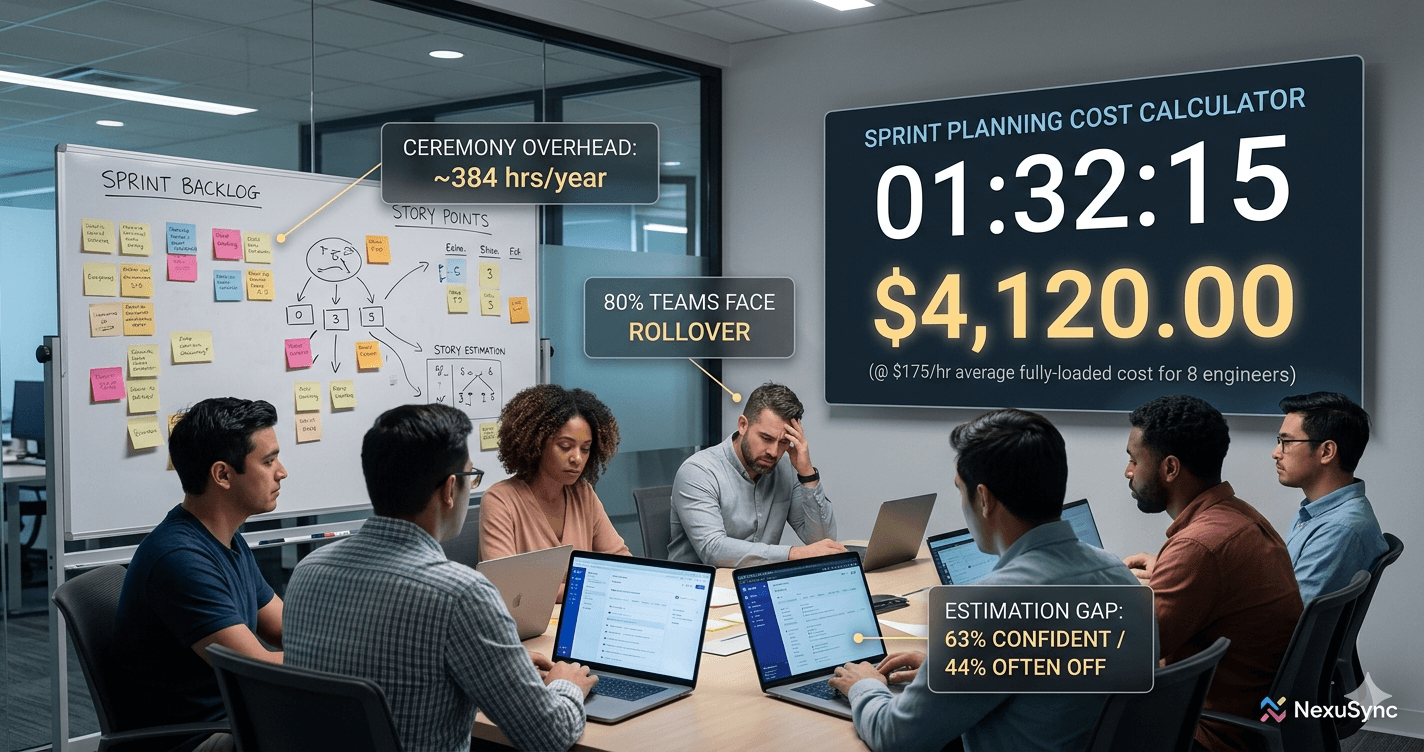
Sprint planning isn't free. It's billed at $200 to $400 per hour per engineer sitting in a room estimating story points on work nobody fully understands yet. Most teams treat it as an unavoidable cost of running Agile. It isn't. It's a tax on output, and most engineering leaders have never actually measured the bill.
The Complete Guide to Continuous Planning for Software Teams
Key Takeaways
- 63% of teams feel confident in their estimates, yet 44% are significantly off at least half the time, it's an information problem, not a skills problem.
- A typical 8-person team burns 384 engineering-hours per year on sprint planning ceremonies alone
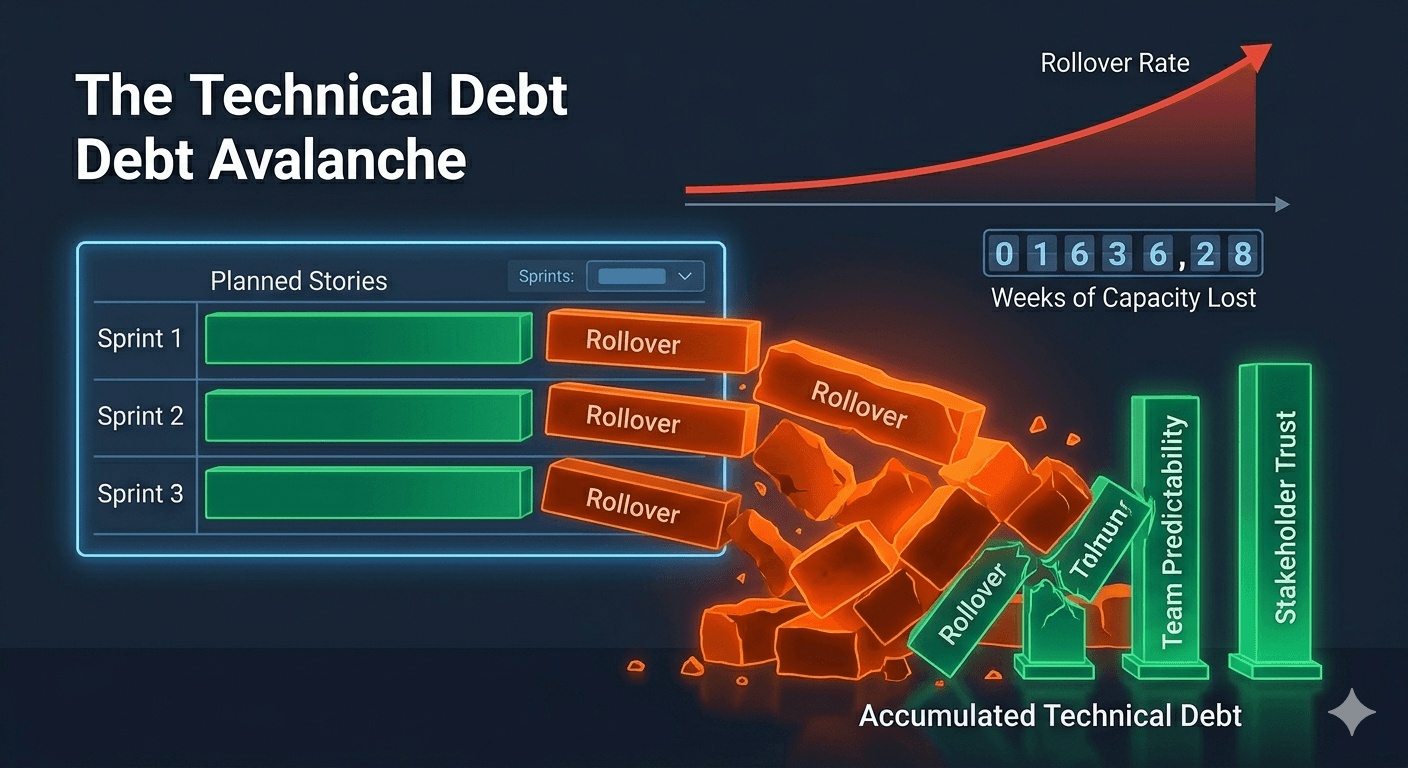
- 80% of Agile teams carry incomplete work into the next sprint, compounding overhead sprint over sprint
- Eliminating overhead means removing the mechanical work of planning, not the discipline of planning
- AI-native planning tools can recover up to 35% of PM admin time immediately
What Does Sprint Planning Actually Cost Your Team?
Sprint planning overhead isn't a minor inconvenience. According to PMI's Pulse of the Profession 2026, 31% of complex projects fail to achieve intended benefits, more than double the 12% rate from 2024 (PMI Pulse of the Profession, May 2026). A significant part of that failure starts in the planning room. For an 8-person team running two-week sprints, a two-hour planning session equals 16 engineering-hours per sprint. That's 32 hours per month, and roughly 384 hours per year, consumed before a single line of code is written.
At a fully-loaded engineering cost of $150 to $200 per hour, those 384 hours represent $57,600 to $76,800 per year on ceremony alone. That figure doesn't include pre-planning grooming sessions, post-sprint replanning when the plan breaks, or the productivity drag from context-switching in and out of planning mode.
Why 80% of Agile Sprints Roll Over (and How to Fix It)
Most engineering leaders would immediately cut any vendor contract worth $57,000 that delivered zero output. Yet the same leaders treat the equivalent planning cost as non-negotiable overhead. It isn't.
Annual Sprint Planning Ceremony Cost by Team Size
Horizontal bar chartThe Five Places Overhead Hides
The ceremony is the visible part. The real overhead lives in four other places most teams never track. Asana's research shows 60% of knowledge worker time is spent on "work about work", status chasing, unnecessary meetings, and tool switching (Asana Anatomy of Work, 2026). Sprint planning multiplies every one of those patterns.
Here's where the hours actually go:
1. The ceremony itself. Two hours of calendar time, multiplied by headcount. This is the only part teams ever measure.
2. Pre-planning prep. Story writing, backlog grooming, and estimation sessions that happen before the official planning meeting. Most teams run a separate grooming session each sprint. Add another 1 to 2 hours per engineer.
3. Rollover debt. When stories roll over, they don't just move, they regenerate overhead. The rolled story gets re-estimated, re-discussed, and re-prioritized. 80% of Agile teams carry incomplete work into the next sprint; only 20% report minimal rollover (Easy Agile Research, Feb 2026, n=419 across 5 countries). That means 4 in 5 teams are paying planning costs on the same work twice.
4. Mid-sprint replanning. Reality diverges from the plan. A dependency slips. An incident consumes two days. A stakeholder changes scope. The team doesn't formally replan, but individuals resequence their work, burning hours without a meeting on the calendar.
5. Status reporting. 50% of project teams spend one full day or more each month manually collating project status information (Wellingtone State of PM, 2024). That's 12 days per year generating reports that describe what the plan was, not what's actually happening.
Add items two through five to your ceremony cost estimate. The real number will surprise you.
Why Do Confident Teams Still Miss Estimates?
The estimation paradox is the clearest sign that planning overhead isn't a process problem. 63% of practitioners feel highly confident in their estimates, yet 44% report that tasks end up significantly off-estimate at least half the time (Easy Agile Research, Feb 2026). Think about that for a moment. Nearly two-thirds of teams feel good about their estimates. Nearly half are regularly wrong by a significant margin.
This isn't a skills problem. Engineers who have been estimating for years are not getting better at estimation. The confidence gap persists because the problem is structural, not individual.
The problem isn't the estimators. It's the information environment in which estimation happens.
The Sprint Planning Confidence Gap
Teams who feel confident in their estimates      ████████████████████████████████ 63%
Teams regularly significantly off on estimates   ████████████████████ 44%
Confidence ≠ Accuracy. Source: Easy Agile Research, Feb 2026, n=419 across 5 countries
The Sprint Planning Confidence Gap
Two-bar horizontal chartThe Dependency Problem Nobody Talks About
36% of Agile teams cite dependency delays as the top cause of sprint rollover (Easy Agile Research, Feb 2026). Dependencies are the most predictable source of plan failure, and almost nobody tracks them in real time.
Here's the typical failure mode. Team A's work blocks Team B's story. Both teams know this at planning time. Someone makes a note. No system enforces it. Team A slips by three days because their own work was under-estimated. Team B's stories are now blocked, but nobody triggers an alert. The dependency lives in someone's memory, or in a Jira field that hasn't been updated since planning day.
By the time Team B notices mid-sprint, they've already started context-switching onto other work. The blocked stories either roll over or get partially completed. Both outcomes generate more overhead in the next sprint.
The fix isn't better Jira hygiene. It's a planning system that maps dependencies automatically and surfaces blockers before they become emergencies. When a ticket moves, the dependency register should update. When a blocker forms, the affected team should know immediately, not during the next standup.

What Does "Eliminating Overhead" Actually Mean?
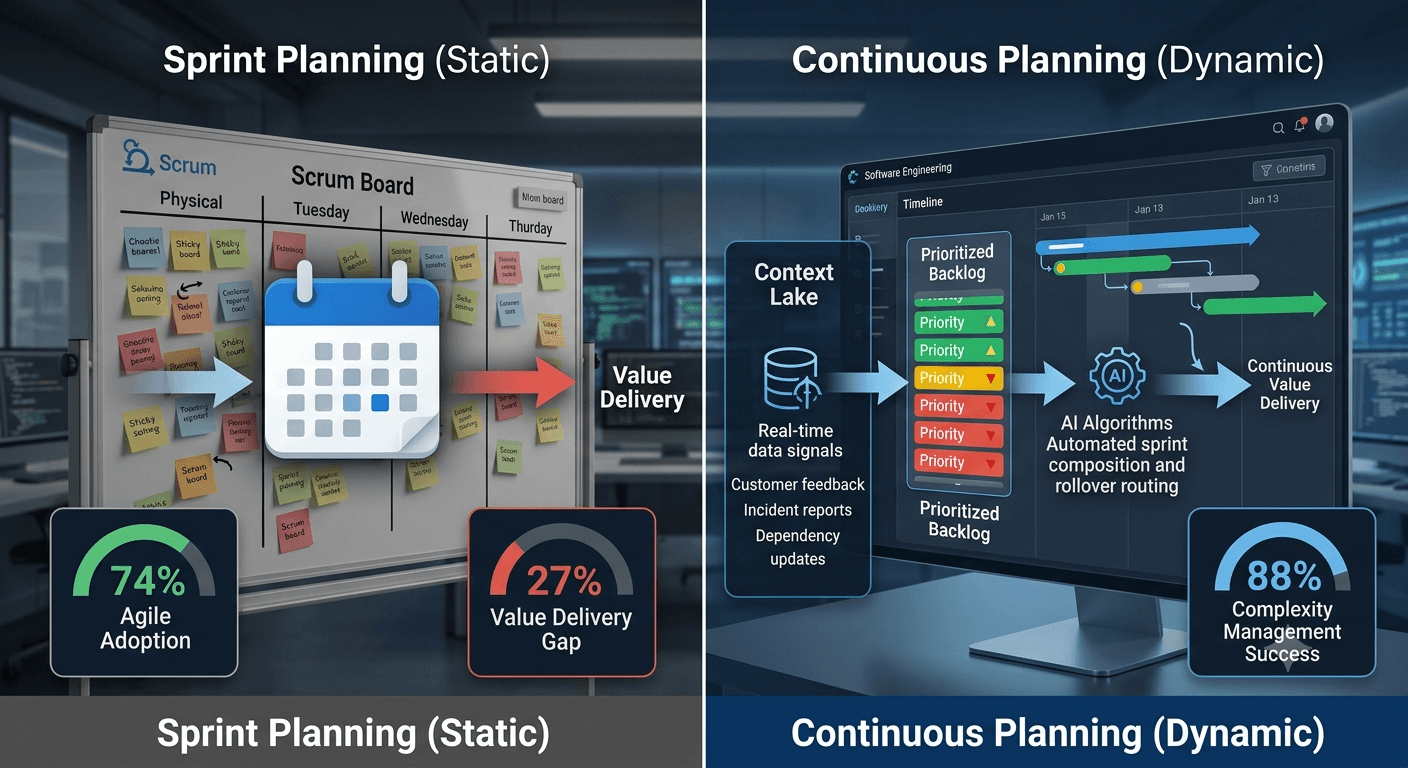
Eliminating overhead doesn't mean eliminating planning. The discipline stays. Deciding priorities, reviewing capacity, identifying risk, those conversations still happen and they should. What disappears is the mechanical work: writing user stories from scratch every sprint, manually estimating work without full context, copy-pasting information between tools, maintaining a backlog that decays between sprints.
PMI's 2026 data underscores the stakes. 80% of complex projects experience negative fallout from poorly managed complexity; 55% miss deadlines (PMI Pulse of the Profession, May 2026). Poor planning is the direct cause of most of that fallout. But the solution isn't more planning time, it's better planning inputs.

What Is a Context Lake? The AI-Native Planning Memory Layer
That's the distinction worth making. Automation should remove the parts of planning that don't require human judgment, and preserve the parts that do.
How Can You Reduce Sprint Planning Overhead Starting This Sprint?
You don't need to overhaul your entire process in one sprint. Four changes will materially reduce overhead regardless of which tools you use.
Step 1: Audit your actual planning time. Log hours for one sprint: the ceremony, pre-planning grooming, and the first three days of reactive replanning. Don't guess, track it. Most teams discover they're spending 30 to 50% more time than they estimated. The audit alone changes the conversation.
Step 2: Eliminate pre-planning as a separate ceremony. Stories should be ready before planning starts, not written during it. If your team is writing stories in the planning meeting, you're running two ceremonies and calling one of them planning. Separate story creation from sprint planning and run them on different days with a minimum 48-hour gap.
Step 3: Automate dependency mapping. Build a dependency register that updates when tickets move, not when a human remembers to update it. On your existing stack, even a Jira webhook that posts to Slack when a blocker forms catches 60 to 70% of mid-sprint dependency surprises before they compound. AI-native planning platforms maintain the full dependency graph continuously, surfacing blockers before they're manually flagged, not after.
Step 4: Measure rollover rate as a primary planning metric. If more than 20% of your stories roll over to the next sprint, your planning process is broken. Don't fix the sprint, fix the root cause. Rollover is a symptom. Over-commitment, dependency failures, and estimation variance are the causes. Measure all three.
What Do Teams Using AI-Native Planning Actually Report?
AI can save project managers up to 35% of time on administrative tasks (PwC AI Jobs Barometer, 2025). The teams capturing that gain aren't using AI to write individual user stories. They're using AI at the system level: generating the sprint plan from a live context graph, tracking dependencies automatically, and flagging velocity risk before the sprint starts.
The difference matters. Point-solution AI, paste a task description, get a user story, reduces the friction of one task. System-level AI eliminates the entire category of mechanical planning work. One is a productivity improvement. The other is a structural change to how planning operates.
59% of teams still use spreadsheets for sprint planning; only 33% use Jira's native boards (Easy Agile Research, Feb 2026). That means the majority of teams are running a modern engineering process on tools designed for static data entry. The overhead those teams carry isn't inevitable, it's a product of the tooling gap.
The teams seeing the strongest ROI on AI planning tools are doing one thing differently: they're feeding the AI system the same information a strong engineering manager would have before sitting down to plan. Codebase history. Team capacity. Past retrospective findings. Open dependencies. When the AI has that context, it plans like a senior person who's been on the team for two years. When it doesn't, it hallucinates story points and misses every dependency.
Time your next sprint planning session. Include prep time, the ceremony, and the first three days of reactive replanning. Then decide if that's a good use of your team's time.
Frequently Asked Questions
How do I calculate the true cost of sprint planning for my team?
Multiply your team size by hours spent on: the planning ceremony, pre-planning grooming, and mid-sprint reactive replanning. Apply your fully-loaded engineering rate ($150 to $200/hr is a common benchmark). Most 8-person teams land at $57,000 to $76,000 per year on ceremony alone, before counting rollover and replanning costs (Easy Agile Research, Feb 2026).
Is a 20% sprint rollover rate actually bad?
Yes. 80% of Agile teams carry incomplete work forward (Easy Agile Research, Feb 2026, n=419), which teams often normalize as expected. But rollover compounds: rolled stories get re-estimated, re-planned, and re-discussed. A chronic 20%+ rollover rate signals a broken planning process, not bad luck. Fix estimation inputs and dependency tracking before adjusting velocity targets.
What's the difference between sprint planning and continuous planning?
Sprint planning is a periodic ceremony tied to a fixed cadence. Continuous planning treats the plan as a living document that updates as new information arrives, capacity changes, dependencies shift, priorities evolve. The ceremony becomes a review, not a creation event. Teams that shift to continuous planning report significantly lower replanning cycles mid-sprint.
Can AI planning tools work with existing Jira and Linear setups?
Most AI-native planning tools integrate with existing ticket systems rather than replacing them. The AI layer reads your backlog, dependency graph, and historical velocity, then generates or updates the sprint plan within your existing workflow. The ticket system stays; the manual overhead of populating and maintaining it disappears.
Why do teams with experienced engineers still miss estimates so badly?
Because estimation accuracy depends on information quality, not seniority. 63% of practitioners feel highly confident in their estimates, yet 44% are significantly off at least half the time (Easy Agile Research, Feb 2026). Senior engineers pattern-match from experience, which works until the work is novel, the dependency graph is complex, or capacity assumptions are wrong. Better planning inputs, full context, live dependency maps, accurate capacity, close the gap faster than estimation training.